Swept up in a collision of neon and noise, Ximending stands as a Wanhua District stronghold and the heart of Taipei’s modern identity. Just steps from MRT Ximen Station (Exit 6), the neighborhood — often dubbed the “Shibuya of Taiwan” — draws over three million monthly visitors into its labyrinth of cosmetics boutiques, street food stalls, and technicolor digital billboards. Yet, amidst the relentless current of evening street performances and fashion-forward crowds, one can find pockets of calm where ancient rhythms persist in a modern key.
Beneath the strobe-lit canopy of the main thoroughfare, the frenetic energy of the city narrows into the focused frame of a single workbench. Nestled behind a plexiglass partition sits an anonymous artisan operating with the exacting composure of a surgeon. He reaches into one of twenty colorful plastic canisters and pinches off a mentally-calculated mass of air-dry foam clay. His gaze flickers between his hands and a glowing smartphone screen, where a candid photograph of a curious dog serves as his only reference. With a few deft rotations, he kneads the material into a smooth, oblong sphere and attaches it to a wooden dowel as the structural foundation for a new creation.
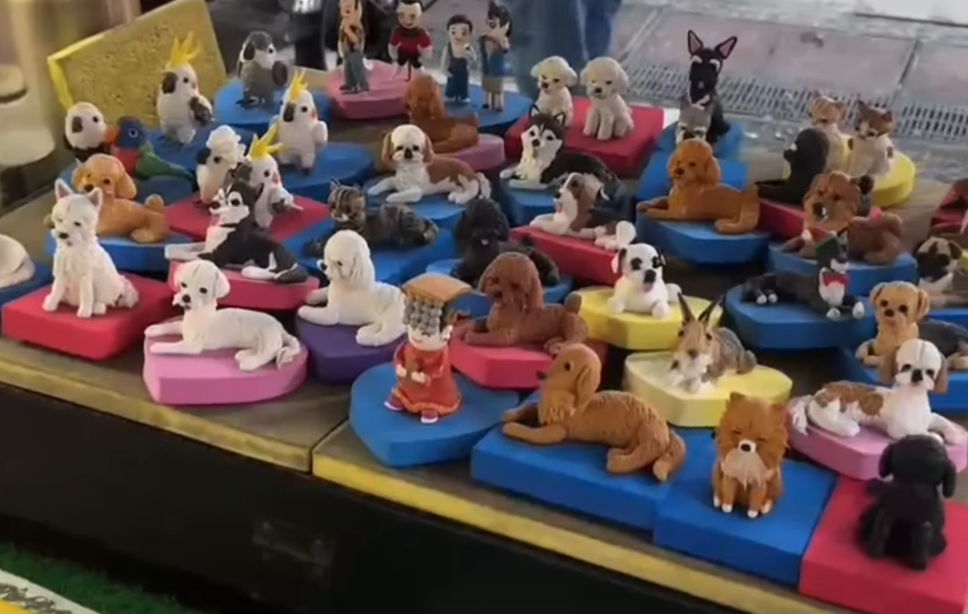
Detailed clay pet figurines by a street artist in Ximendong, Taipei. Each one is made within an hour.
From Flour to Foam Clay
Though the clay medium used is a contemporary synthetic, the artisan’s hands move with the ancestral logic of Nie Mian Ren (捏麵人) — traditional Chinese dough sculpting. Literally translating to “pinch,” “flour,” and “person,” the art form has survived for centuries as a nomadic folk craft, born from the temple festivals of ancient China. Traditionally, these figures were sculpted from a humble mixture of wheat and glutinous rice flour, tinted with vegetable dyes to depict legendary heroes and mythical beasts. While considered momentary artifacts rich with significance, they were ultimately prone to the cracking of time and the appetites of nature.
Yet through evolution, the ancient craft has found a place in the modern corridors of Taipei. Substituting perishable starches with resilient, lightweight foam clay has allowed the craft to shift from temporary folklore to a permanent keepsake. Where ancient temple courtyards once hosted these masters, the bustling neon sidewalks now provide the stage for a new kind of alchemy.
The Sculpting Process
Lined up along his stall are hand-scrawled placards in Chinese, English, Thai, and Korean — a linguistic bridge to the global crowd flowing through the district. Among them, a note reveals the craftsman’s pedigree: over 30 years of experience dedicated to the manual arts. His signage promises that anything “can be sculpted as long as there is a photo” (有相片即可捏作) and that he specializes in people, pets, and the whimsical world of cartoons.
While many patrons arrive with photos of their beloved dogs and cats, the artist’s portfolio spans the animal kingdom, with displays ranging from hollow-boned birds to the bold, ornate silhouettes of traditional Lion Dancers and Asian deities. Within an hour, he materializes a cherished two-dimensional digital memory into a tangible, 3D tribute, making the complex physics of his craft look completely effortless. Essentially a street performance centered on manual dexterity, he pinches perky ears into existence, inlays obsidian-beady eyes, and uses a scalpel to snip the texture of a scruffy muzzle. He cycles through a specialized kit of tweezers and brushes, combing out the fine details of a cuddly coat before tacking on a playful, pink sliver for a tongue.
For 350 NTD (roughly 10 USD), the finished miniature is mounted on a signature heart-shaped foam board and packaged into a minimalist cardboard box. Handed over to an eager pet parent, the piece comes with a final, vital instruction: “Do not touch for a week.” In the heart of a district that never stops moving, the clay fur baby demands a final lesson in patience, curing slowly into a permanent artifact of the Ximending night.
For those seeking their own miniature, the artisan is a fixture of the Ximending nightlife, usually found stationed near H&M. Look for small placards reading H32, W19, W31, or W46 to find the master at work.
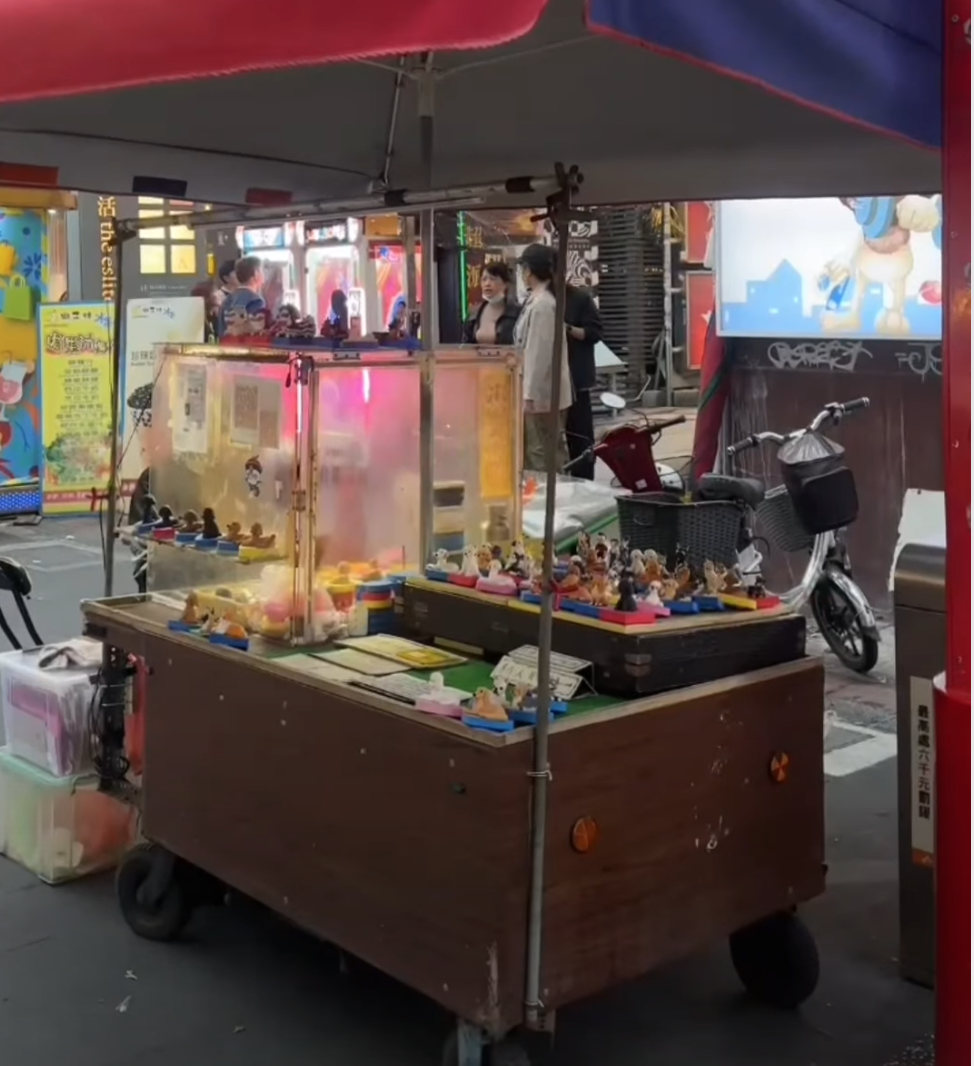
An artisan’s stall in Ximending, Taipei, where the ancient craft of Nie Mian Ren (dough sculpting) is reimagined. He distills over 30 years of mastery into lifelike clay miniatures of a customer’s most cherished companion.
Stall Information:
H32, W19, W31, and W46 ⚲
Wanhua District, Taipei City, Taiwan
Open 1830 — 2230