Now open at London’s Design Museum, NIGO: From Japan with Love marks the first museum retrospective of NIGO (Tomoaki Nagao), founder of A Bathing Ape (BAPE) and Human Made, and a key force in bridging streetwear and luxury fashion. His influence has spent three decades redefining how we perceive the intersection of high-end manufacturing and street-level subcultures.t
Co-curated with Esme Hawes, the exhibition brings together over 700 objects, including a meticulous reconstruction of the creative director’s teenage bedroom, rare garments, music ephemera, ceramics, and a full-scale glass tea house — tracing a practice that moves across fashion, music, and 1980s Tokyo culture. The extensive collection places it alongside recent large-scale surveys, including Verdy’s I Believe in Me, reflecting a broader museum-grade appreciation for contemporary streetwear.
Yet even a show of this size is only a fragment of his world. For NIGO, the exhibition is but an affectionate postcard from the “final boss” of archivists; a concise dispatch drawn from a massive personal collection of over 10,000 objects accumulated over a lifetime of curation.
From the backstreets of Ura-Harajuku to the global stage, the show charts a 30-year career that has fundamentally reshaped contemporary style. It explores the Ura-Hara movement’s transition from a niche Tokyo subculture into a global design language that dictates modern luxury today. By offering a rare glimpse into NIGO’s private archives, collaborators, and the cultural instincts behind his most work, the show reveals the hidden narratives of a visionary who treats every object as a vital piece of history.
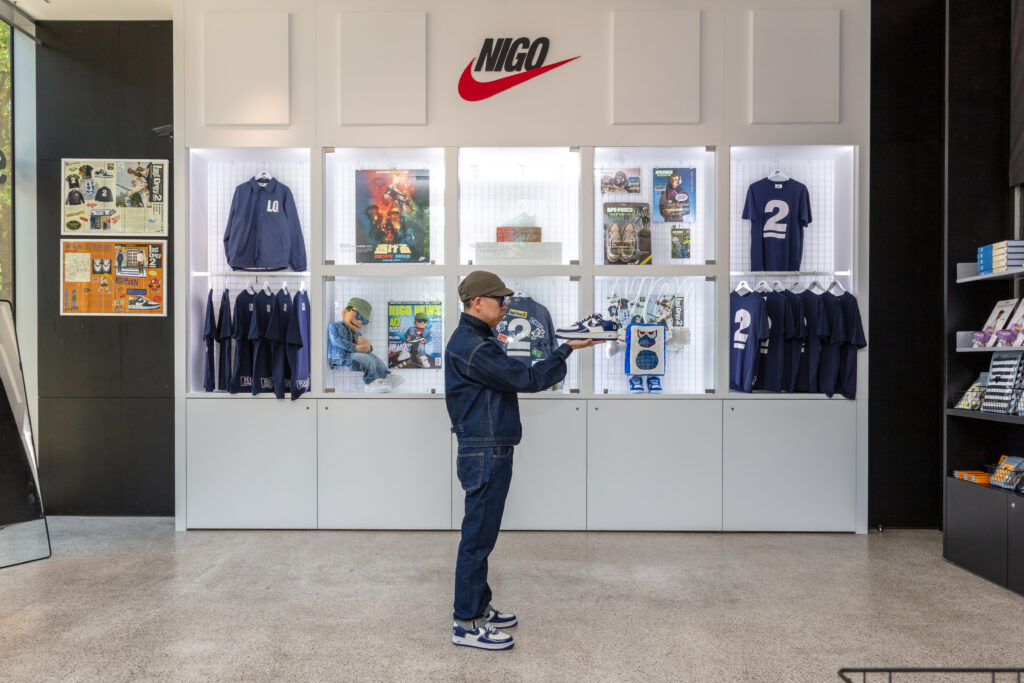
NIGO launches his Nike x Nigo LO2 (Last Orgy 2) Air Force 1 and apparel collection exclusively with the Design Museum exhibition.
Tracing His Footsteps
NIGO: From Japan With Love unfolds as a curated sequence of rooms, each tied to a defining era of his development. From his foundational youth in Maebashi, Japan, to his later high-fashion ventures across luxury and ceramics, the exhibition traces Nigo’s creative life built through obsessive acts of making, collecting, and collaboration — offering a focused snapshot of his creative universe.
Maebashi, Gunma Prefecture
The journey begins with a reconstruction of Tomoaki Nagao’s 1980s teenage bedroom in Maebashi, filled with records, clothes, toys, and posters that reveal an early affinity for American pop culture — from skateboards and scooters to Star Wars figurines and stacks of Levi’s denim. Personal objects like a Donald Duck figurine bought with New Year’s money sit alongside nods to icons such as Felix the Cat, hinting at the visual language he would later reinterpret.
The journey begins with a vivid reconstruction of Tomoaki Nagao’s 1980s teenage bedroom in Maebashi. This space is filled with the artifacts such as records, clothes, toys, and posters that reveal an early affinity for American pop culture — ranging from vintage skateboards and scooters to Star Wars figurines and foundational stacks of Levi’s denim. Personal objects, such as a Donald Duck figurine bought with New Year’s money, sit alongside nods to mid-century icons like Felix the Cat, hinting at the visual language he would later reinterpret.
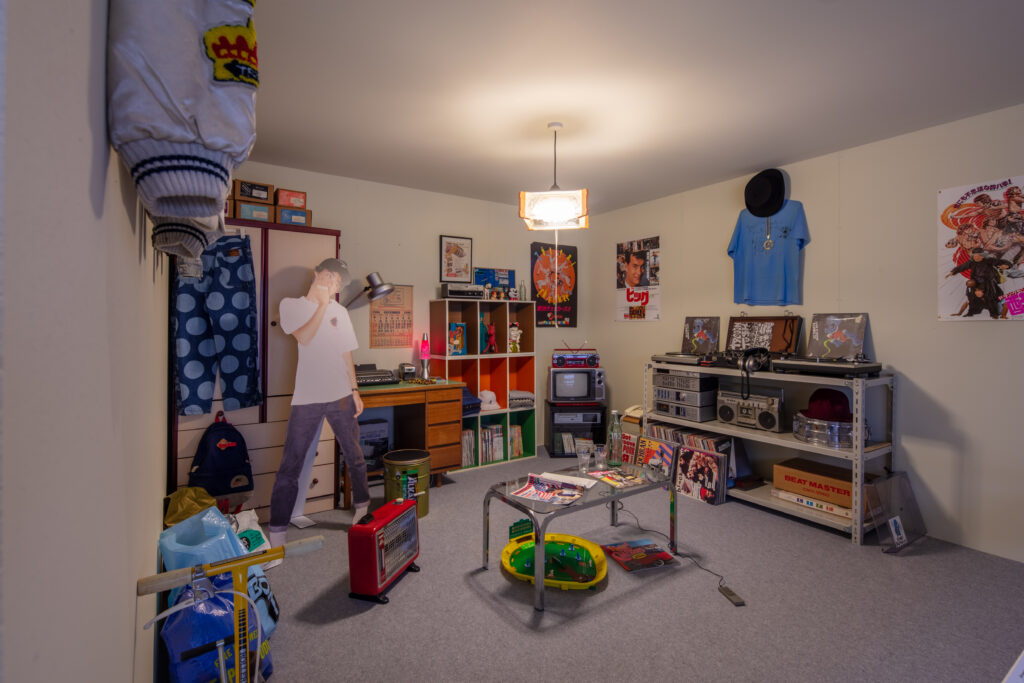
Inside teenage Nigo’s 1980s bedroom. It features a life-size cutout of young NIGO (Tomoaki Nagao) alongside collectables that reveal his early affinity for American pop culture.
Leaving Maebashi for Tokyo, Nagao immersed himself in the city’s emerging street culture, where he eventually came under the mentorship of Hiroshi Fujiwara. Working as his assistant, he earned the moniker “NIGO” (ニゴー), meaning “number two,” a reflection of both his resemblance to Fujiwara and his role at his side. From this position, NIGO began shaping the instincts that would materialize into his own brand, A Bathing Ape (BAPE).
A Bathing Ape Era
In 1993, NIGO co-founded the NOWHERE store with Jun Takahashi in the backstreets of Harajuku, a foundational hub that would become the epicenter for the Ura-Harajuku style movement. Here, A Bathing Ape took shape alongside Takahashi’s UNDERCOVER, fusing punk attitude with Japanese streetwear sensibility.
The exhibition presents an eclectic collection of early, era-defining BAPE pieces alongside rare collaborations that amplified its reach. This includes a 2001 project with Pepsi, the 2003 Super Ape Star sneakers with Adidas, exclusives with Nintendo, Chrome Hearts, The Simpsons, and many, many more. A dedicated display to Teriyaki Boyz sits within this moment, as BAPE expanded from a local movement into a global cultural force.
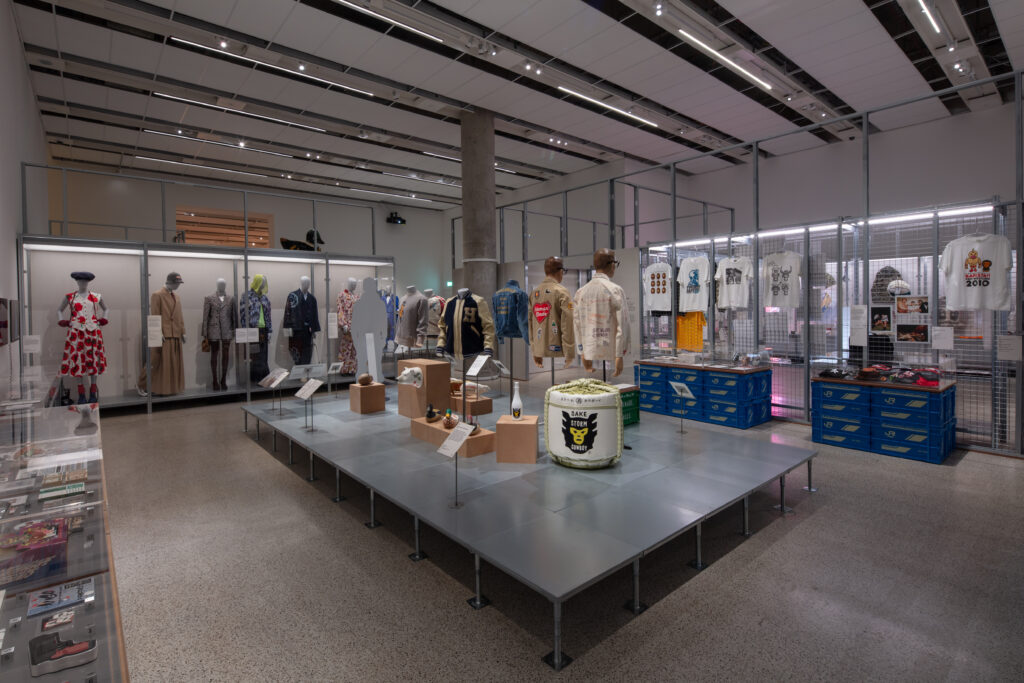
A glimpse of NIGO’s current era with Human Made, Kenzo, and LVMH at the Design Museum, London.
Human Made, Kenzo, LVMH
The next chapter of the exhibition focuses on NIGO’s current output, sharing exclusive pieces from Human Made, his tenure at Kenzo as artistic director, and collaborations with Pharrell and LVMH. Garments, graphics, and objects display a refined version of his visual language where references to vintage Americana, workwear, and archival detail are crafted with greater precision. Highlights include Kenzo runway pieces and Kid Cudi’s blue suit worn at the 2022 Met Gala. The selection is a continuation of his earlier instincts, bridging the energy of streetwear with luxury practices.
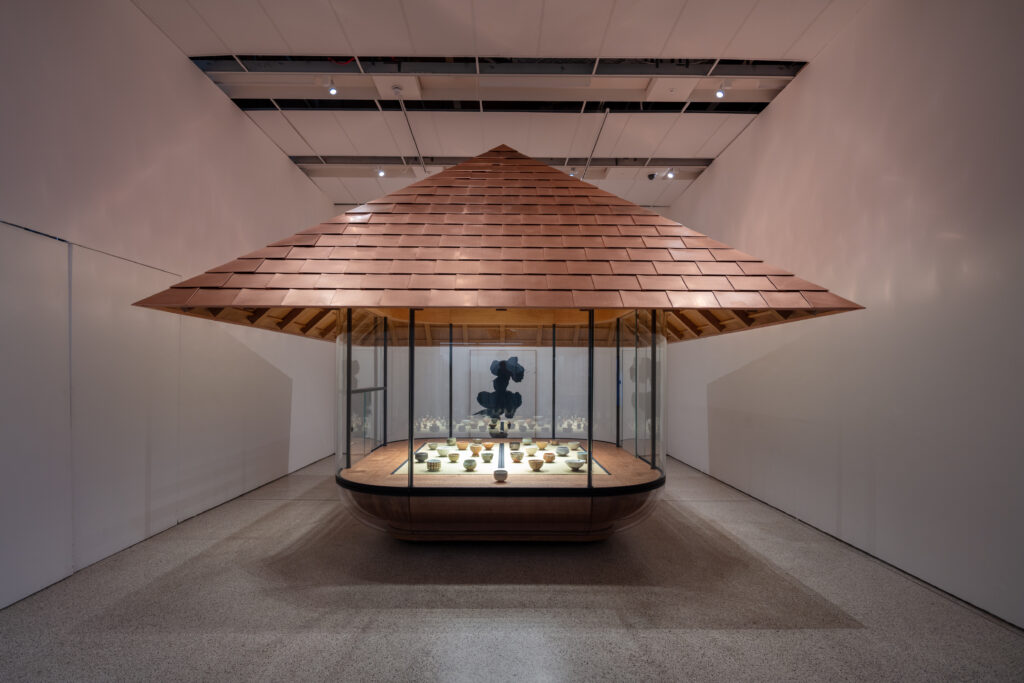
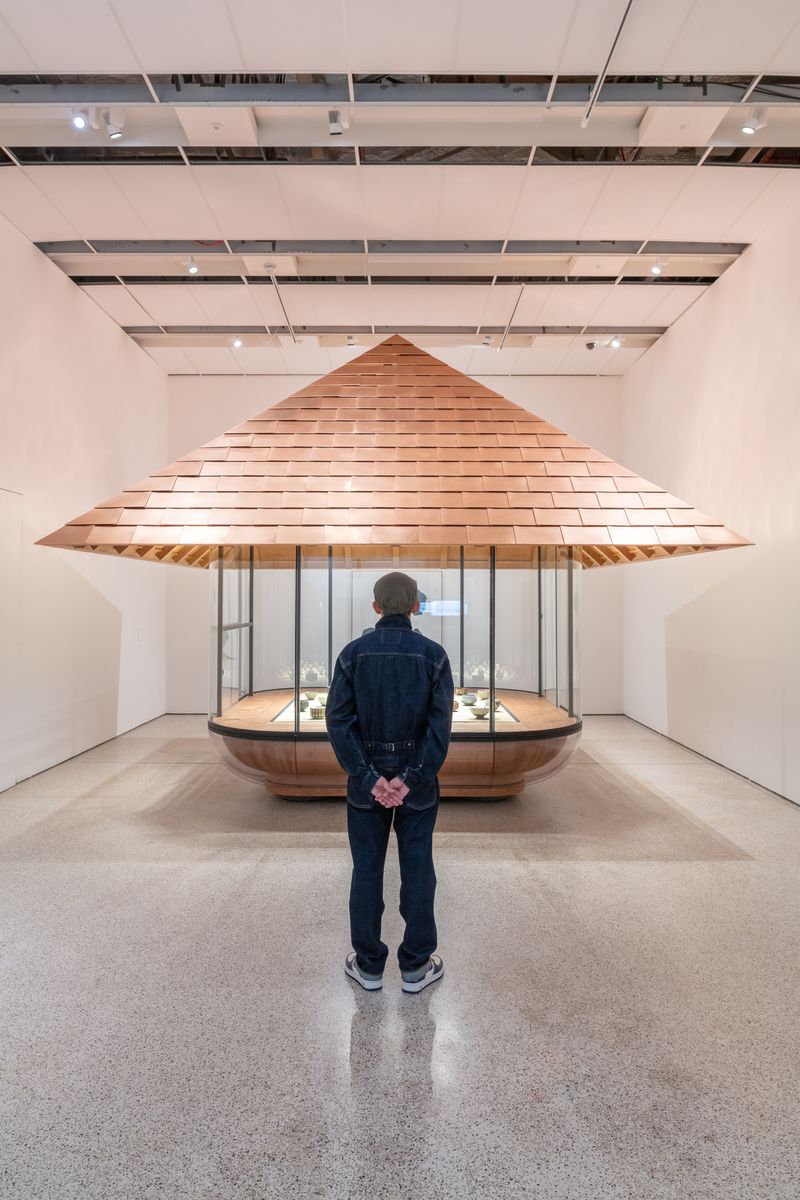
NIGO: From Japan with Love closes with a custom-made chashitsu by NOT A HOTEL. It houses 25 of Nigo’s hand-thrown chawan and is backdropped by a painting that reads “老” or “old age” by late calligrapher Yūichi Inoue.
Chashitsu (茶室)
The exhibition closes with a life-size tea house created specially for this show. The chashitsu (茶室), designed by NIGO in collaboration with hospitality brand NOT A HOTEL, is built with glass walls and a copper-tiled roof — a modern nod to traditional Japanese architecture. It houses 25 of NIGO’s original hand-thrown chawan (tea bowls), a small sample of a craft he has honed over a decade of travels across Japan.
His close relationship with chawan-making naturally led him into tea practice itself. Working intimately with the vessel, and learning through his wife, Riho Makise — who teaches and practices tea ceremony — he gradually began training in chadō (茶道), or the “Way of Tea,” once again branching into another field of craft.
Centered behind the structure is a painting from his archive by late calligrapher Yūichi Inoue. In bold ink, it reads 老 (rō), meaning “old age” — a fitting note as NIGO continues to translate enduring Japanese practices through his contemporary lens.
Exhibition Information
NIGO: From Japan with Love ⚲
Design Museum, London
224-238 Kensington High St, London W8 6AG, United Kingdom
Open 1000 — 1700, 5.01 — 10.04
Images courtesy of Design Museum