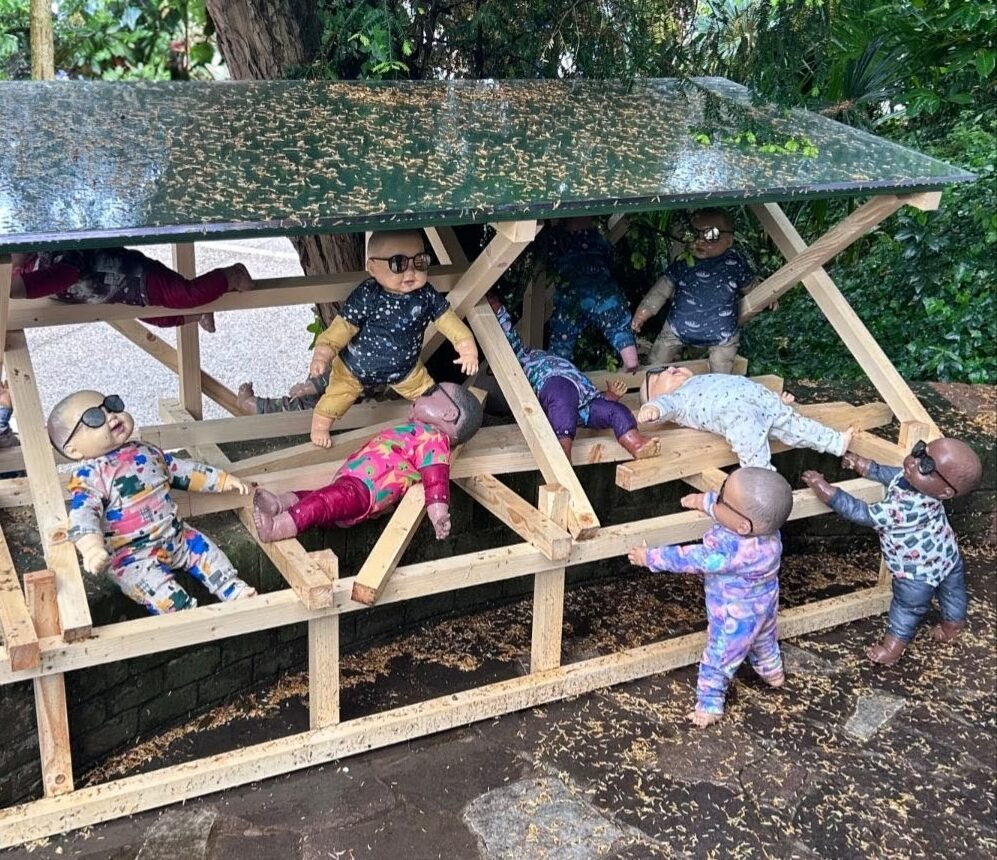
As if twins weren’t enough, Japanese-American performance artist and professor Ei Arakawa-Nash has delivered 208 more for his exhibition Grass Babies, Moon Babies. Commissioned for the Japan Pavilion’s 70th-anniversary presentation at the 2026 Venice Biennale and co-curated by Lisa Horikawa and Mizuki Takahashi, the installation transforms the historic space into a surreal, pint-sized spectacle.
Grass Babies, Moon Babies
In Venice, tucked behind a curtain of sippy cups and milk-filled bottles, lies a pavilion overtaken by over 200 chilled-out, shade-wearing infants. Arakawa-Nash explains that the concept for Grass Babies, Moon Babies was born shortly after he was approached by the Japan Pavilion, back when his own twins, Yunta and Soh, were just four months old. Inspired by the visceral realities of new parenthood and the 1962 family comedy Being Two Isn’t Easy — a film following young parents in post-war Japan — Arakawa-Nash dedicated this playful project to his sons.
Where Babies Reign Supreme
Upon entering, guests are invited into a cheeky immersive experience in which they are offered a 6kg doll — roughly the weight of a 4-month-old — available in a spectrum of skin tones. Acting as caretakers for a day with a baby in hand, visitors are then freed to wander the pavilion’s garden and interior, where babies reign supreme.
Set to a backtrack of whimpers and giggles, the space radiates a contagious joy. Everywhere you look, chubby dolls are caught doing questionable things with mischievous expressions. In one corner, future action heroes hold dramatic poses while descending from ropes and baskets; in another, uncoordinated mini-humans dangle off scaffolding and furniture. A few lounge in front of the TV — or attempt to climb it — while others play hide-and-seek in the garden, scaling trees and tasting things they probably shouldn’t. Each one is dressed in a vibrant onesie, their fearlessness hidden behind a pair of mirrored sunglasses.
Bold Baby Wardrobe
Born from Arakawa-Nash’s creative mind, these babies also received care from their grandmother. Their colorful outfits were hand-sewn by the artist’s mother, Miwako Arakawa, and her friends in Fukushima. The textiles themselves were designed by the collective NUNO, who used generative AI to create patterns based on dates, poems, and events significant to Arakawa-Nash and the Japanese diaspora.
As for the mirrored sunglasses? While their exact creator remains a mystery, they likely take their style cues from the Arakawa-Nash twins’ personal wardrobe. More importantly, they serve a conceptual purpose: as guests carry the dolls, the mirrored lenses reflect the visitors back to themselves, prompting a sudden awareness of the weight of childcare and the intense, reflective gaze of parenthood.
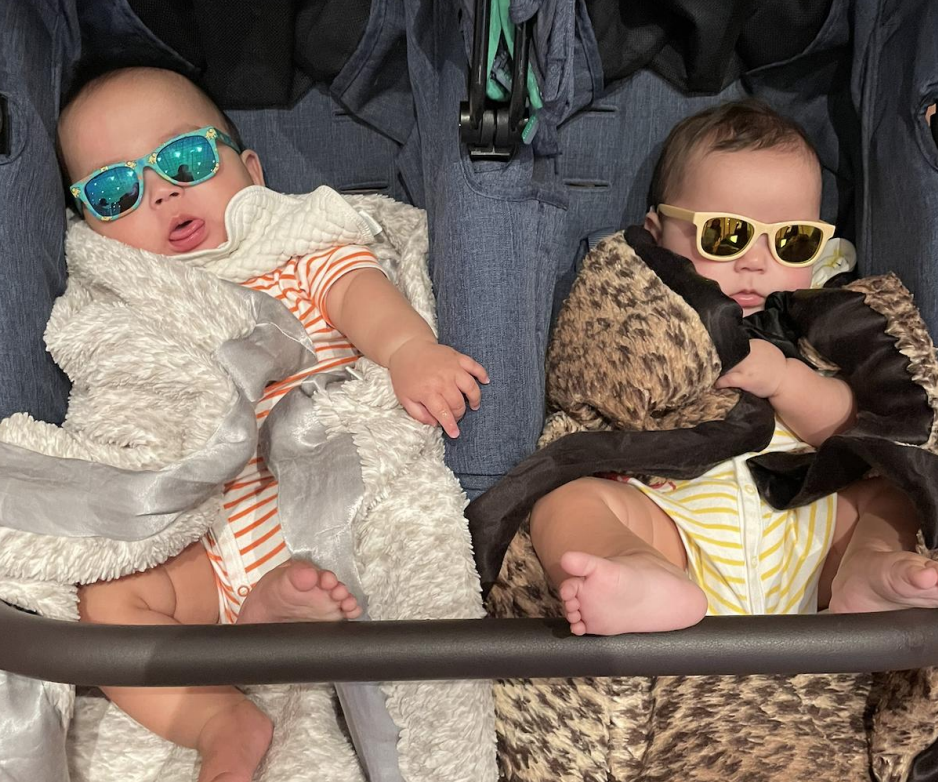
Yunta and Soh Arakawa-Nash: The original muses. Their stroller poses are now immortalized across 200+ siblings at the Japan Pavilion’s 70th anniversary, Venice Biennale.
(Courtesy of Japan Foundation | Arakawa-Nash)
Garden and Moon Significance
While the double “babies” in the title is a nod to the artist’s twins, the sheer scale and title of Grass Babies, Moon Babies serve as a living tribute to the Japan Pavilion itself. Arakawa-Nash pays homage to the late architect Takamasa Yoshizaka, who designed the structure 70 years ago. By spilling the exhibition into the greenery, he encourages guests to circulate through the architecture as Yoshizaka intended — as a space without rigid borders.
The title also honors the experimental Sogetsu Art Center, whose name (草月流) translates literally to “Grass Moon Flow.” This center was a cornerstone of inspiration for Arakawa-Nash during his formative years in New York.
In this context, if the “grass” represents the physical grounding of the garden, the “moon” references the fluid nature of time and emotion. To capture this ephemeral quality, Arakawa-Nash collaborated with renowned Japanese astrologer and writer Yukari Ishii. Drawing on her deep affinity for lunar cycles, Ishii composed individualized poems for the installation, weaving together the cosmic and the historical to give each baby a soul rooted in the Japanese diaspora.
QR Diapers
The experience concludes at a communal changing table, where guests perform the final act of care: changing their fictional baby’s diaper. Unbuttoning the onesie and unravelling the diaper reveals a hidden QR code which, when scanned, delivers a specific poem written by Ishii for that doll.
Each piece of prose is uniquely informed by the baby’s name, birth location, and a birthday tied to a significant historical milestone. Whether the code reveals the date of a war, the passing of Arakawa-Nash’s father, or the birth of the first IVF baby, the encounter serves as a poignant reminder that no child is a blank slate. Every baby is born into a world already heavy with history, implying that caring for others is both a physical act and a collective responsibility of memory.
Life persists regardless of global conflict; babies continue to be born into every corner of the world as symbols of pure joy and unwritten potential. By holding one, the focus shifts away from the “self” and evokes a sense of accountability for another life. This forces us to confront the urgent question: “What kind of world are we building for them to inherit?”
Stork Travels
Following the Venice Biennale, Grass Babies, Moon Babies will travel to the Kestner Gesellschaft in Hannover, Germany, before its final presentation at the Artizon Museum, Tokyo in 2027. Once the tour concludes, these crowdfunded babies will be stork-delivered to their respective forever families, carrying their travels, history, and poems home with them.
Exhibition Information:
Grass Babies, Moon Babies ⚲
Japan Pavilion, Castello, 30100, Venezia VE, Italy
Open 1100 — 1900, 5.09 — 11.22
Closed Mondays