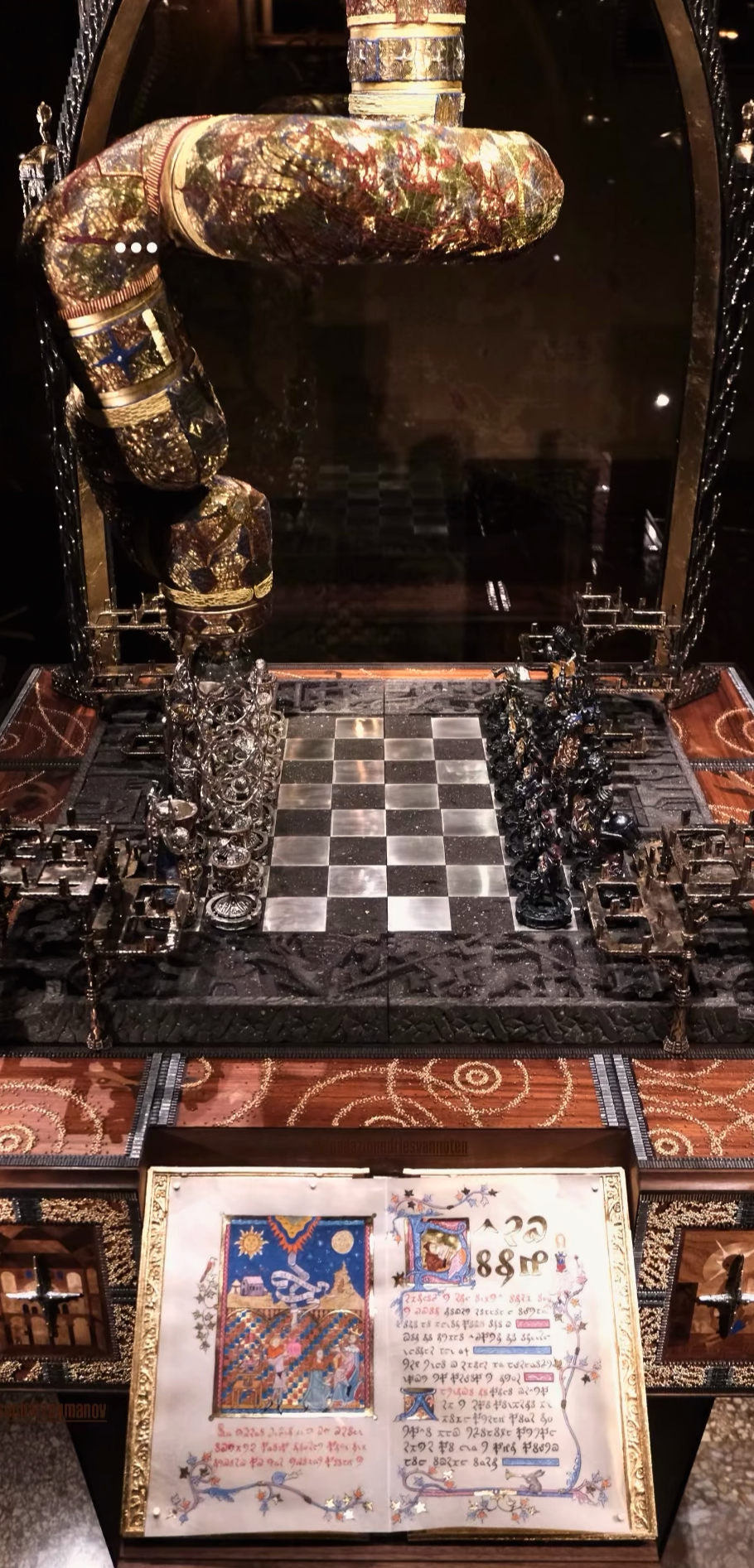
On the second floor of Venice’s Palazzo Pisani Moretta, a lavish game of chess unfolds. Simulating the improbable chain of events that led to his grandparents’ meeting during the Cold War, 23-year-old French-Armenian artist Joseph Arzoumanov immortalizes their love story through L’Échiquier des Songes — The Chessboard of Dreams — now on view as part of the Fondazione Dries Van Noten exhibition The Only True Protest Is Beauty.
Blending traditional crafts from around the world with robotics and AI, the multifaceted installation reflects the young artist’s richly layered cultural and artistic lineage, shaped in part by his grandfather, Soviet-Armenian composer Valéry Arzoumanov.
L’Échiquier des Songes — The Chessboard of Dreams
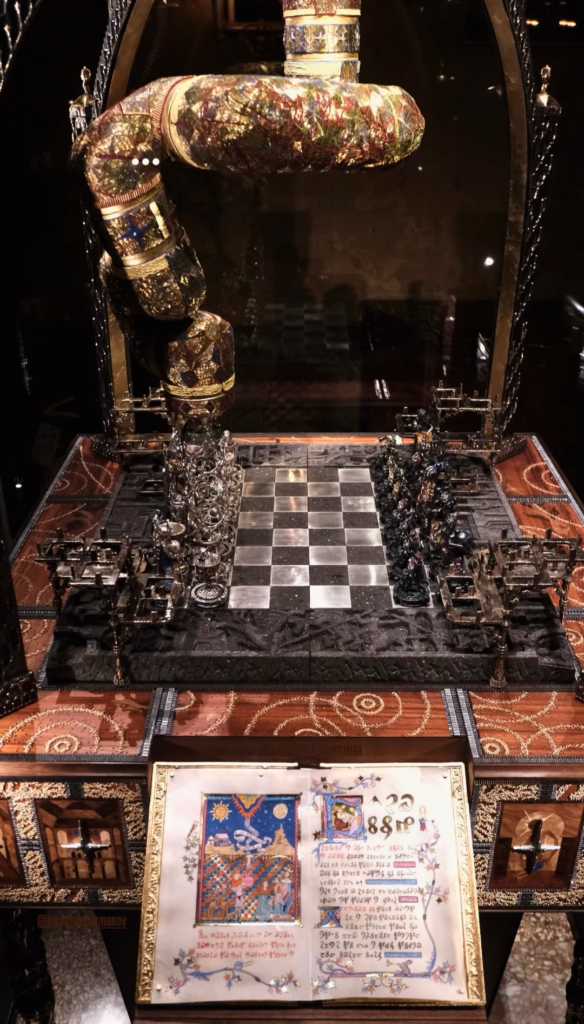
Encased within the music room of the Palazzo Pisani Moretta, a gold and silk embroidered robotic arm performs what may be one of the world’s most extravagant games of chess. Developed over the course of three years with the support of designer Dries Van Noten, the Albertine Foundation, Antoine Camus, and more than 23 artisans and craftspeople, Joseph Arzoumanov transforms the centuries-old strategy game into an intricate meditation on love, memory, and fate.
Resting atop a marquetry wood embroidered table by Jean-Brieuc Atelier and set upon a hand-carved Armenian Khachkar volcanic stone checkerboard are 32 jeweled chessmen sculpted from blackened silver and adorned with gold, silk, and precious stones. Rather than depicting war, the opposing forces represent the love story of the Arzoumanov family itself. The Silver King stands in for Joseph’s grandfather, while the Black Queen represents his grandmother.
Above the board, four Gothic steel arches support a glyphically carved mother-of-pearl reliquary that hovers like a sacred object suspended in the air. Within it rests a small glass perfume vessel containing a custom olfactory interpretation by Alexandre Helwani, while a divine-like figure holding a scepter overlooks the scene below. Extending beneath it, the robotic arm meanders as though guided by an unseen force.
Powered by AI decision-making, the mechanism continuously plays endless chess variations, exploring alternate pathways and hypothetical outcomes that may or may not have led the lovers together. More than a technological spectacle, the machine behaves like an oracle of probability — endlessly calculating fate through movement and repetition. Using a silver cage-like apparatus, the arm envelops, rotates around, and interlocks with each chessman through a system of stabilizing prongs designed to safely lift and maneuver the jeweled figures across the board.
Two illuminated vellum manuscript pages sit before the installation, produced using Voynich-style 14th-century materials and techniques, while a dreamlike piano composition by grandfather Valéry Arzoumanov fills the room in the background.
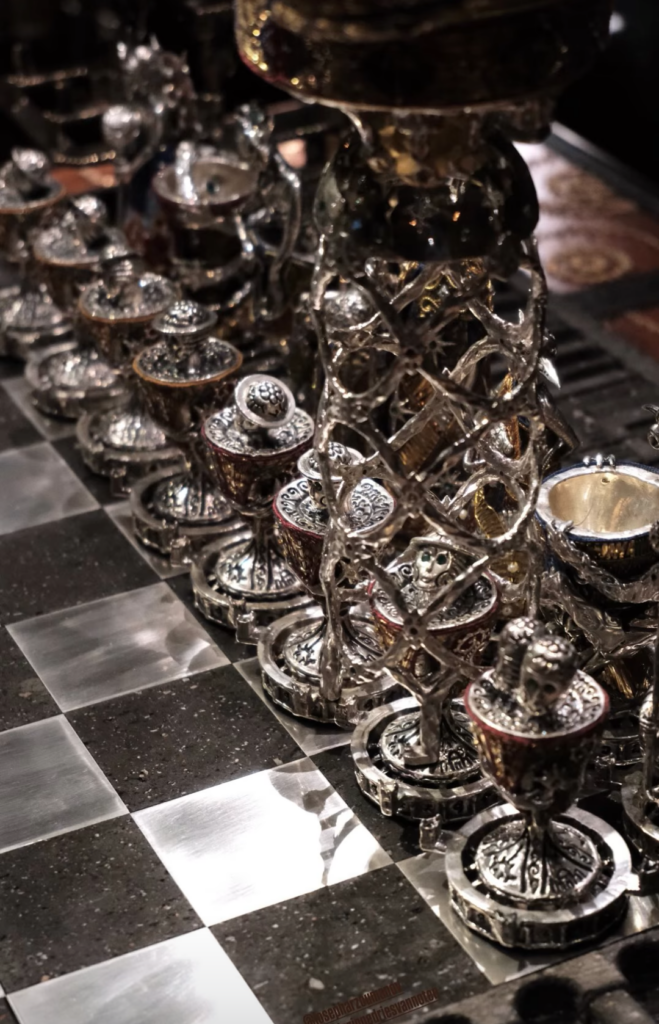
Silver cage apparatus picking up one of grandpa’s pawns in Joseph Arzoumanov’s Chessboard of Dreams.
Joseph Arzoumanov
A modern-day self-described treasure hunter, Joseph Arzoumanov grew up collecting and assembling materials, drawn to the archaeological worlds he dreamed of discovering as a child. Unable to excavate these imagined treasures himself, he instead learned to create them — personally studying the crafts, materials, and technologies needed to bring them into existence.
Today, the young French-Armenian artist is known for blending traditional craftsmanship with emerging technologies, moving fluidly between embroidery, sculpture, jewelry, robotics programming, and 3D modelling. He credits embroidery as his gateway into craft, which gradually led him toward sculpture, goldsmithing, and eventually a mentorship in jewelry-making.
His education has unfolded across multiple countries and disciplines: sculpting Khachkar in Armenia; studying embroidery in Uzbekistan, India, and the United Arab Emirates; exploring Bedouin weaving and braiding in Abu Dhabi; and developing programming and digital modelling skills in the United States. This interdisciplinary approach has quickly established Arzoumanov as one of the most promising young talents within the French art scene.
That openness to craft traditions and cultural exchange is deeply rooted in his family history. Raised in a Franco-Russian household with Armenian and Jewish ancestry, Joseph grew up surrounded by multiple cultural worlds — an inheritance anchored by his grandfather, Valéry Arzoumanov.
The Arzoumanov Love Story
History should have kept them apart, yet somehow they found each other.
At the emotional center of L’Échiquier des Songes lies the real-life love story of Joseph Arzoumanov’s grandparents, who met in the USSR near Leningrad — now Saint Petersburg — along the shore of a frozen sea during the Cold War. Within the installation, their encounter is imagined not as a singular inevitability, but as one fragile possibility among countless alternate realities.
Joseph’s grandfather, Valéry Arzoumanov, was a celebrated Soviet-Armenian composer known for orchestral, chamber, and film-related works often described as dreamlike and lyrically intense. Frequently referred to as a “composer outside of time,” his life eventually changed course after marrying a French woman, leading to his exile from the Soviet Union.
Against the backdrop of a politically divided world, their meeting carries an almost cinematic improbability. The frozen sea becomes both a literal setting and a metaphor: two people finding warmth and intimacy within an era defined by ideological tension, borders, and separation. From that improbable encounter would eventually emerge the lineage that led to Joseph himself.
It is this idea of unlikely chances that transforms chess from a game of war into a meditation on destiny. Every move alters the future, and every position contains alternate lives. One changed decision, one delayed journey, one missed glance, and the meeting may have never happened at all. Through the robotic arm’s endless calculations, the installation continuously searches through hypothetical timelines, asking how many invisible moves were required for two people to ultimately find one another.
While chess is often associated with cold strategy and conquest, Arzoumanov reframes the game as something passionately romantic. Within The Chessboard of Dreams, two figures face each other across a board, anticipating, responding, sacrificing, protecting, waiting, and risking. Here, the opposing forces become less about conflict and more about emotional negotiation — a choreography of intimacy unfolding move by move.
Exhibit Information
L’Échiquier des Songes ⚲
The Only True Protest Is Beauty
2F, Palazzo Pisani Moretta
Quartiere San Polo, 2766, 30125 Venezia VE, Italy
Open 1100 — 2300, 4.25 — 10.04