Dior returns to Milan Design Week’s Salone del Mobile with the Corolle lamps created in collaboration with France-based designer Noé Duchaufour-Lawrance. The exhibition features mouth-blown Murano glass pieces inspired by Christian Dior’s seminal 1947 Corolle collection — the “New Look” that redefined post-WWII fashion with its cinched waists and voluminous, inverted flower-like silhouettes.
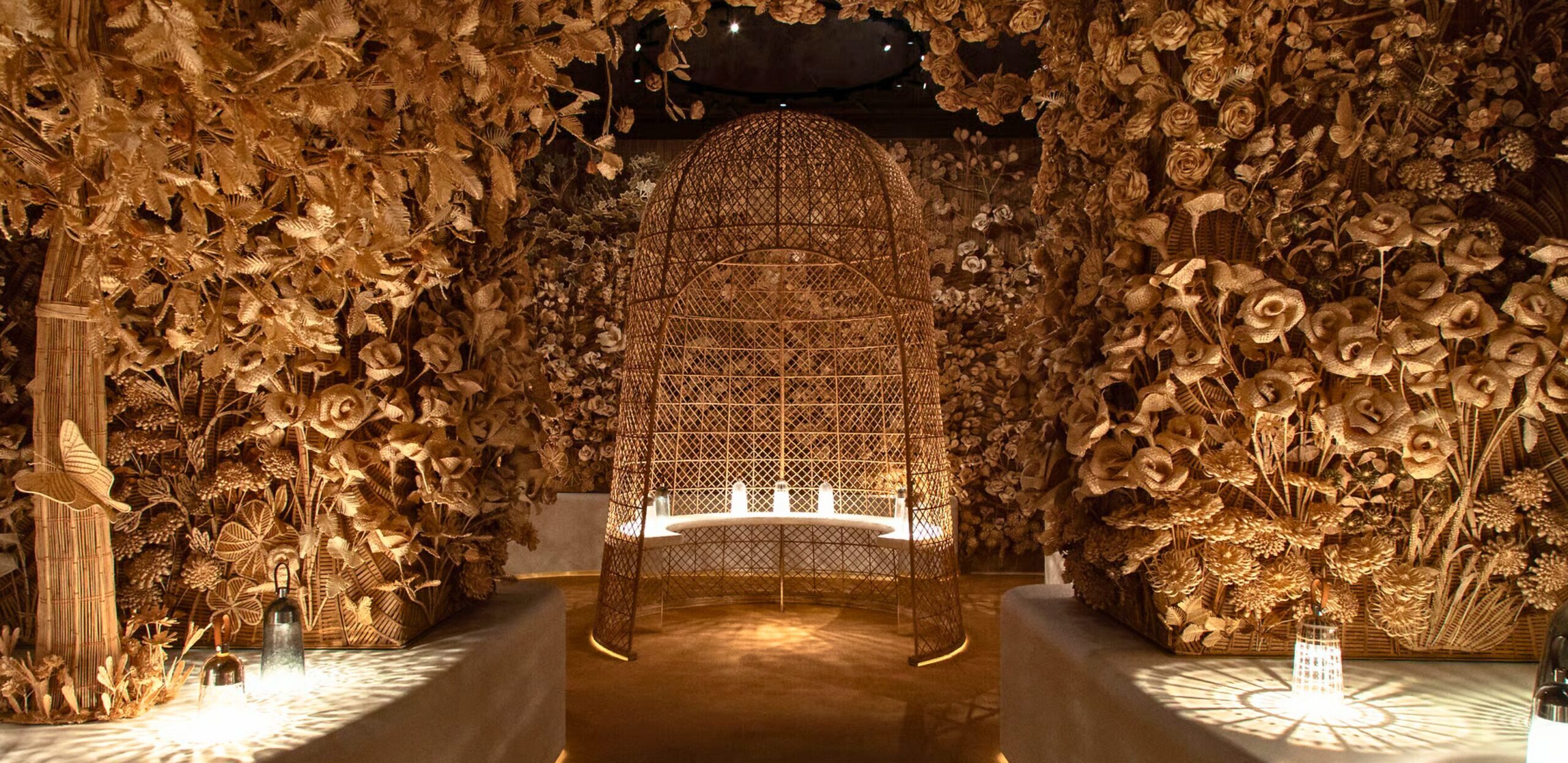
While the lamps capture the light, the atmosphere of the exhibition is anchored by a massive, handwoven botanical garden. Crafted entirely from bamboo, this immersive installation was created by Thai artist and design director Korakot Aromdee and his team. Serving as more than just a backdrop, the woven garden is a structural entry point into Aromdee’s world, where the humble bamboo pole is transformed into an expressive medium.
The Architecture of the Wind
Korakot Aromdee’s journey began in his hometown, Ban Laem, a coastal village perched along the Gulf of Thailand. Known for its salt farms and fishing communities, the area is home to many locals who craft tools and bamboo fishing equipment for a living. Here, craft is not a hobby, but a survival skill. The locals are masters of their environment, crafting bamboo fishing equipment and tools that must withstand the salt and gale. It is also a region of kite makers — artisans who possess an intuitive understanding of wind patterns and aerodynamic tension.
It was here, under the tutelage of his grandfather, that Aromdee mastered the traditional art of Chula kite making. This specific craft requires a sophisticated grasp of physics and material science:
- Bamboo Splicing: Selecting and thinning the wood to achieve the perfect balance of strength and flexibility.
- Binding and Knotting: Using hemp rope and the “tie-and-knot” technique to create joints that move with the wind rather than snapping against it.
These childhood lessons in fluid construction eventually led Aromdee to a Master’s degree in Applied Arts at Silpakorn University. In 2006, he founded Korakot International, a practice dedicated to scaling his techniques into monumental, free-flowing sculptures. Today, his work connects traditional village craft with high-luxury stages around the world.
Café Dior at the luxury house’s Gold House concept store in Bangkok.
(Source: Korakot Aromdee)
Designing with Living Knowledge
Nurturing a creative ecosystem through his studio, Aromdee continues to work closely with local villagers, many of whom possess inherited skills embedded in the lifeblood of coastal life. These men and women grew up mastering netmaking, trawl construction, and complex fastening methods used in pontoon building.
Rather than viewing these as disappearing traditions to be archived in a museum, Aromdee treats them as living knowledge. By applying the same knots used to catch fish in the Gulf of Thailand to the creation of a Dior backdrop, he elevates the status of the artisan. The “tie-and-knot” method allows for a unique visual flow that is both organic and mathematically precise. In the Dior installation, this creates a dialogue with the Murano glass: where the glass is smooth and frozen, the bamboo is textured and rhythmic.
Preserving Culture Through Economic Agency
The significance of Aromdee’s practice extends beyond aesthetics. What began as a small initiative training ten local workers has flourished into a social enterprise of over 60 artisans. By providing stable income and a global platform for their skills, Aromdee has created a viable career pathway for a community that might otherwise have seen its traditional crafts die out in favor of industrial labor.
The studio also functions as a bridge between generations. By bringing contemporary design challenges to the village, Aromdee ensures that the younger generation sees value in the techniques of their elders. Thus, uplift the livelihood of his entire community.
A Collaborative Ecosystem
Aromdee’s process is notably democratic, frequently developing new architectural forms and product lines alongside former university peers and his wider team of artisans. This intersection of academic design theory and practical, hands-on mastery allows the studio to tackle projects of any scale. Together, they form a creative ecosystem where traditional knowledge and contemporary design meet — fostering a creative economy that both preserves and evolves Thai identity.


Aromdee’s work can be found at The Buffalo Amphawa and other renowned venues across Thailand and worldwide.
The Intersection of Luxury and Craft
The collaboration at Salone del Mobile highlights a growing trend in the luxury sector where we return to the hand of the artist. By positioning Aromdee’s fluid bamboo alongside Duchaufour-Lawrance’s crystalline glass, Dior highlights that true luxury resides in the narrative and soul of the maker. This partnership serves as a continuation of a larger movement where Aromdee has become a preferred name for the world’s most storied houses, bridging the gap between ancestral Thai craft and the global stage.
Beyond Milan, Aromdee’s portfolio includes collaborations with Hermès and Louis Vuitton, transforming their retail environments into immersive, living galleries. His influence extends into the fabric of global hospitality, with commissions for five-star resorts, elite spas, and Michelin-starred restaurants worldwide. In every venue, his large-scale natural weaving acts as an organic counterpoint to modern precision, embedding the beauty of coastal traditions into the heart of high-profile design.
This exhibition is a reminder that design is most powerful when it respects its origins. Aromdee’s work is a testament to the fact that the most sophisticated modern designs often have their roots in the salt air and bamboo groves of a fishing village. In his hands, the ancient language of knots becomes a contemporary masterpiece, proving that respect for the past is the strongest foundation for the future.
Exhibition Information
Corolle Lamps ⚲
Palazzo Landriani
Via Borgonuovo 25, Milan, Italy
Open 0900 — 2245, 4.21 — 4.26
Cover image via Dior