Once merely a pair of twigs used for cooking in deep pots 5,000 years ago, the simple chopsticks have spread across Asia as one of the most beloved and versatile eating utensils in human history. With time and travel came vast cultural adaptations. These shifts ranged from differing lengths designed for specific users to intricately carved sets crafted from precious stones and metals for the elite. In the modern era, they evolved again into the ubiquitous disposables stowed in your takeout bags.
One might think that centuries of constant iteration have exhausted the possibilities of these tableside sticks, yet humans still find new ways to innovate within these narrow constraints. For the 64th edition of Milan Design Week, the Shanghai-based platform S–3 presents CHOPSTICKS 箸, an exhibition that proves the evolution is far from over.
Reimagining the Utensil
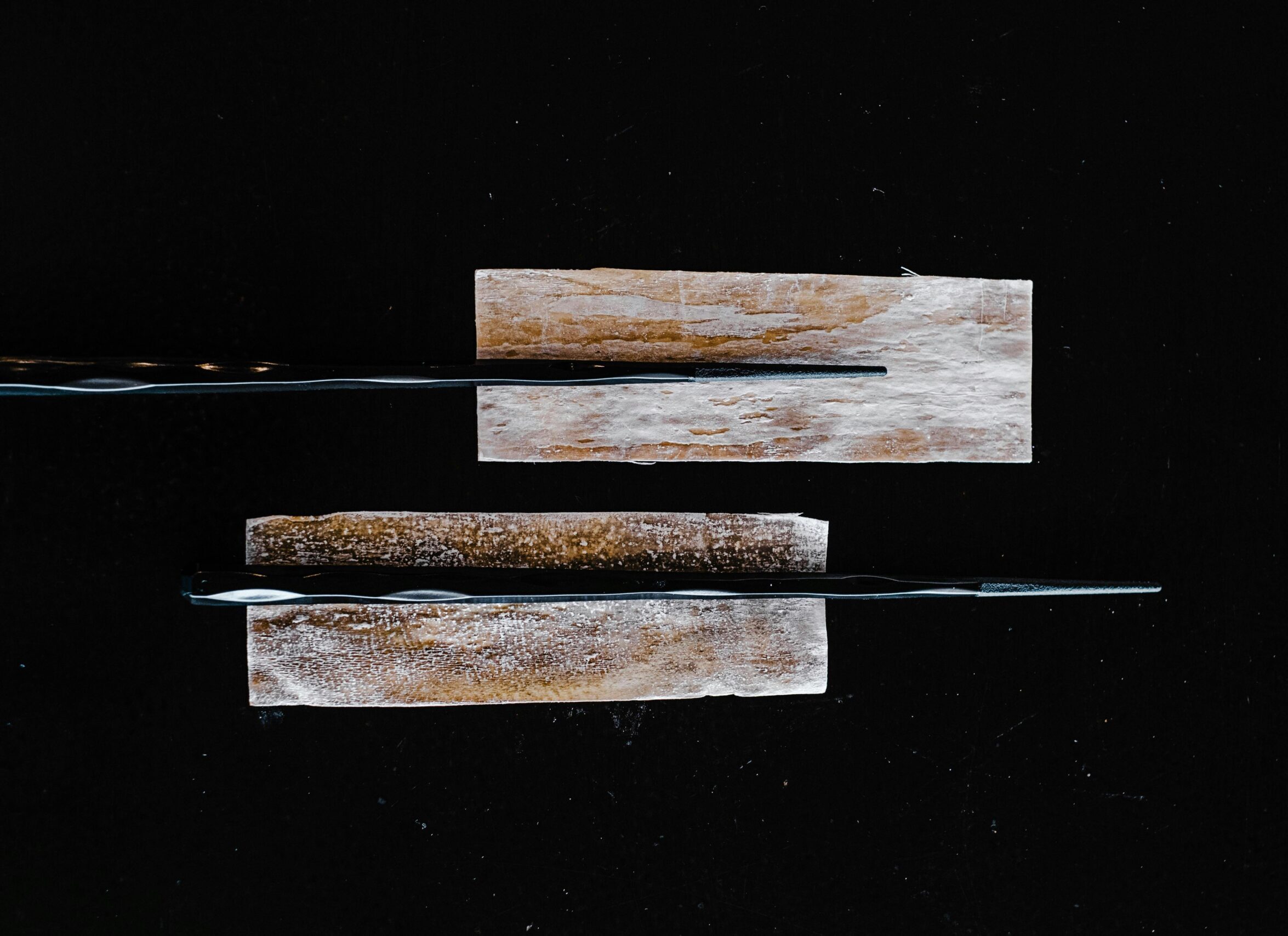
Curated by respected journalist Yoko Choy, the exhibition reframes chopsticks and related objects through the contemporary design lens of sixteen creative teams across Japan, China, and South Korea. The collection serves as a bridge between the humble origin of the tool and the high-tech potential of its future. Among the participants, Mario Tsai Studio takes us back in time with a sharpener that shaves live wood into ancestral forms. This piece highlights the raw connection between the forest and the table, reminding us that the first chopsticks were simply an extension of the hand into the fire.
Meanwhile, other designers are looking toward the horizon of material science. Big-Game, Niceworkshop, and Haus of Hu teleport us into the future with ultra-lightweight carved titanium, ergonomic metal, and modular resin-metal hybrid variations. These designs treat the chopstick as a piece of precision engineering, balancing weight and grip to create a more seamless experience for the modern diner. Jin Kuramoto suggests sustainable options with his Pasta Chopsticks, which offer a witty take on biodegradable materials. At the same time, Aldo Cibic introduces beginner-friendly designs with grippy-tipped surfaces to make the tradition more accessible to a global audience.
The Philosophy of the Stick
Beyond their functional utility, chopsticks represent a specific philosophy of eating that favors mindfulness and communal sharing. Unlike the sharp edges of a fork or knife, chopsticks require a delicate, rhythmic motion that encourages a slower pace of consumption. They are instruments of precision and grace, used to pick up single grains of rice or to separate tender fish with surgical care. In many East Asian cultures, the way one handles their chopsticks is seen as a reflection of their character and upbringing. This exhibition captures that intangible weight, showing that even a simple pair of sticks can carry the heavy burden of cultural identity and social etiquette. By focusing on the tactile feedback and the ergonomics of the tool, the designers invite us to reconsider our most basic daily habits.
A Global Narrative in Milan
The installation is located in the vibrant Sarpi district, which serves as Milan’s historic Chinatown. This intentional choice of venue places the exhibition within a neighborhood that has long been a site of cultural exchange and adaptation. It is not only an ode to the chopsticks themselves, but an invitation for guests to witness how shared traditions can evolve into distinct contemporary narratives.
By linking East Asian design heritage with global creative practice, the exhibition demonstrates that true innovation does not always require inventing something entirely new. Sometimes, the most profound breakthroughs come from looking at a 5,000-year-old object with fresh eyes. As these sixteen teams show, the story of the chopstick is still being written, one elegant pair at a time. The display reinforces a cycle where the archaic becomes the avant-garde, ensuring that this ancient tool remains as relevant on a modern Milanese table as it was beside a Neolithic cooking pot.
Exhibit Information
CHOPSTICKS 箸 by S—3 ⚲
Via Pietro Giannone, 3, 20154 Milano MI, Italy
Open 1000 — 1900, 4.21 — 4.26