In Japan, a cluster of national holidays falls within a single spring week. Known as Golden Week (Ogon Shukan — 黄金週間), this 9–10-day stretch draws widespread travel and vibrant festivals across the country, as people celebrate occasions ranging from imperial commemorations to the arrival of spring greenery. Families return to their hometowns or visit seasonal destinations, while public spaces fill with parades, exhibitions, and open-air events.
Children’s Day (Kodomo no Hi — 子どもの日) closes the week on May 5th, when families honor their young ones — a tradition rooted in over a thousand years of history and most vividly marked by koi streamers (koinobori — 鯉のぼり). Suspended high above rooftops and riverbanks, these wind-caught fabric carps turn the sky into a sea of movement, signaling both celebration and aspiration. They are a visual reminder that growth is a process of navigating the currents of the world.
The Dragon Gate Legend
The koi fish earned its place in Japan’s koinobori tradition through an ancient Chinese legend still read to children today. Titled Tōryūmon (登竜門), or “Gate to Success,” the legend follows a school of koi swimming upstream against the Yellow River — one of the largest rivers on Earth and the second longest in China. Overcoming strong currents, predators, fishermen, and other dangers, only the most determined swim forward. At the journey’s end lies the Dragon Gate waterfall, with rapids described as being swifter than the arrows of a hundred warriors.
Fishes who succeed in leaping over these falls transform into golden dragons and ascend into the sky. Those who do not must repeat the journey year after year. This story serves as a powerful metaphor for the persistence required to overcome the obstacles of life. It teaches children that the struggle against the current is exactly what prepares them for their eventual transformation and success.
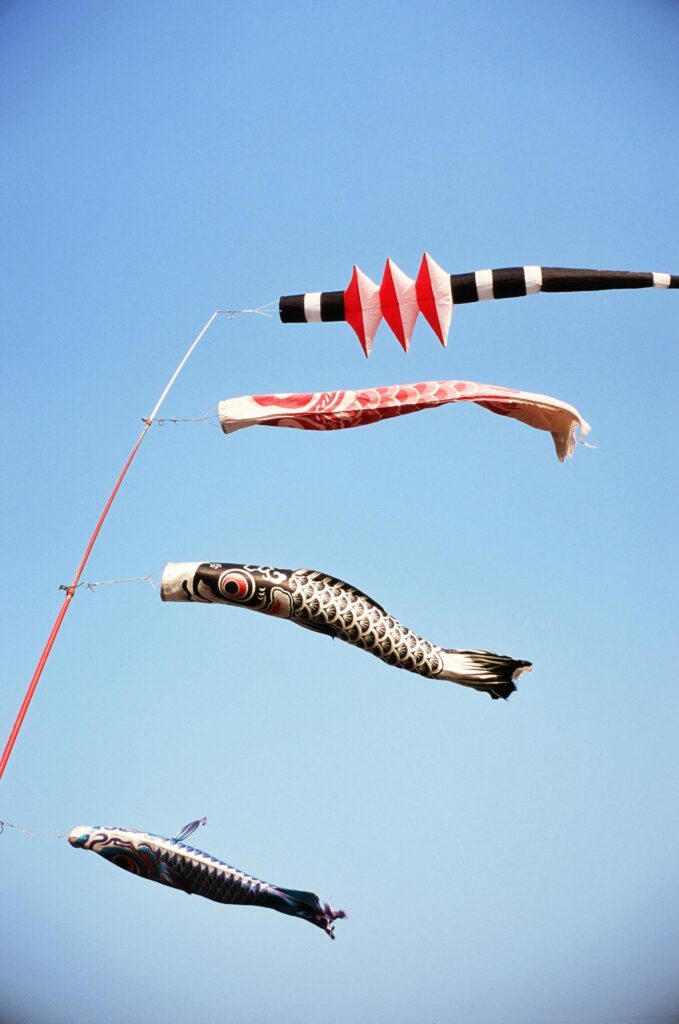
A set of three koinobori streamers hung on Japan’s Children’s Day to pray for the health and success of children. Black koi traditionally represent the father, red the mother or eldest child, and other colors for additional children.
Trendsetting Samurai
The koi’s symbolism of perseverance, courage, and success resonated strongly during the Edo period (1603–1867), when samurai families projected these ideals onto their sons. During this time, warrior households began displaying carp-shaped streamers made from washi paper to mark the birth of boys. These served as both decorations and profound statements of intent for the next generation. These were often accompanied by spinning arrow wheels, multi-colored windsocks, and samurai helmets and armor — each carrying protective and aspirational meanings. Together, they formed a visual symbol of strength, resilience, and lineage to honor their sons.
Though the display was originally practiced only among the warrior class, it eventually evolved into a wider cultural tradition adopted by the general public as a prayer for children’s health and success.
The Anatomy of the Streamer
Beyond the fish themselves, the traditional koinobori pole is topped with symbolic objects that help the carp reach the heavens. At the very top sits a pair of yaguruma (矢車), spinning arrow wheels designed to drive away evil spirits with their constant motion and metallic sound. They also act as a spiritual compass, catching the wind and announcing the family’s prayers to the heavens.
Below the wheels, a multi-colored windsock called a fukinagashi (吹き流し) represents the five elements — wood, fire, earth, metal, and water. This vibrant streamer is believed to protect the children from illness and misfortune by creating a sacred path for the koi to follow.
Each component of the setup works in harmony to ensure that the family’s prayers are carried as high as possible into the spring sky. The bright colors against the blue sky serve as a beacon of hope and vitality after the long winter months.
Children’s Day in the Modern Era
Today, koinobori still rise on Children’s Day and carry wishes for the well-being, strength, and future of the next generation. Typically displayed in sets of three or more, these vibrant koi streamers vary in color and size, rippling swiftly with the wind across rivers, rooftops, and open skies. In recent decades, the holiday has evolved from its original focus on boys to become a day that celebrates the happiness and individual personalities of all children.
The largest black koi traditionally represents the father, followed by a red koi for the mother or eldest child, and additional colors assigned to younger siblings. Their arrangement forms a flowing hierarchy that mirrors the family unit. In motion, each fish moves independently yet stays connected to the same pole, representing a family that thrives together through the changing winds of life.
This collective dance in the sky serves as a beautiful reminder that every child, like the koi, has the potential to leap over their own waterfalls. By honoring these ancient legends and modern rituals, we provide the next generation with the raw materials necessary to build their own narratives of success and resilience.