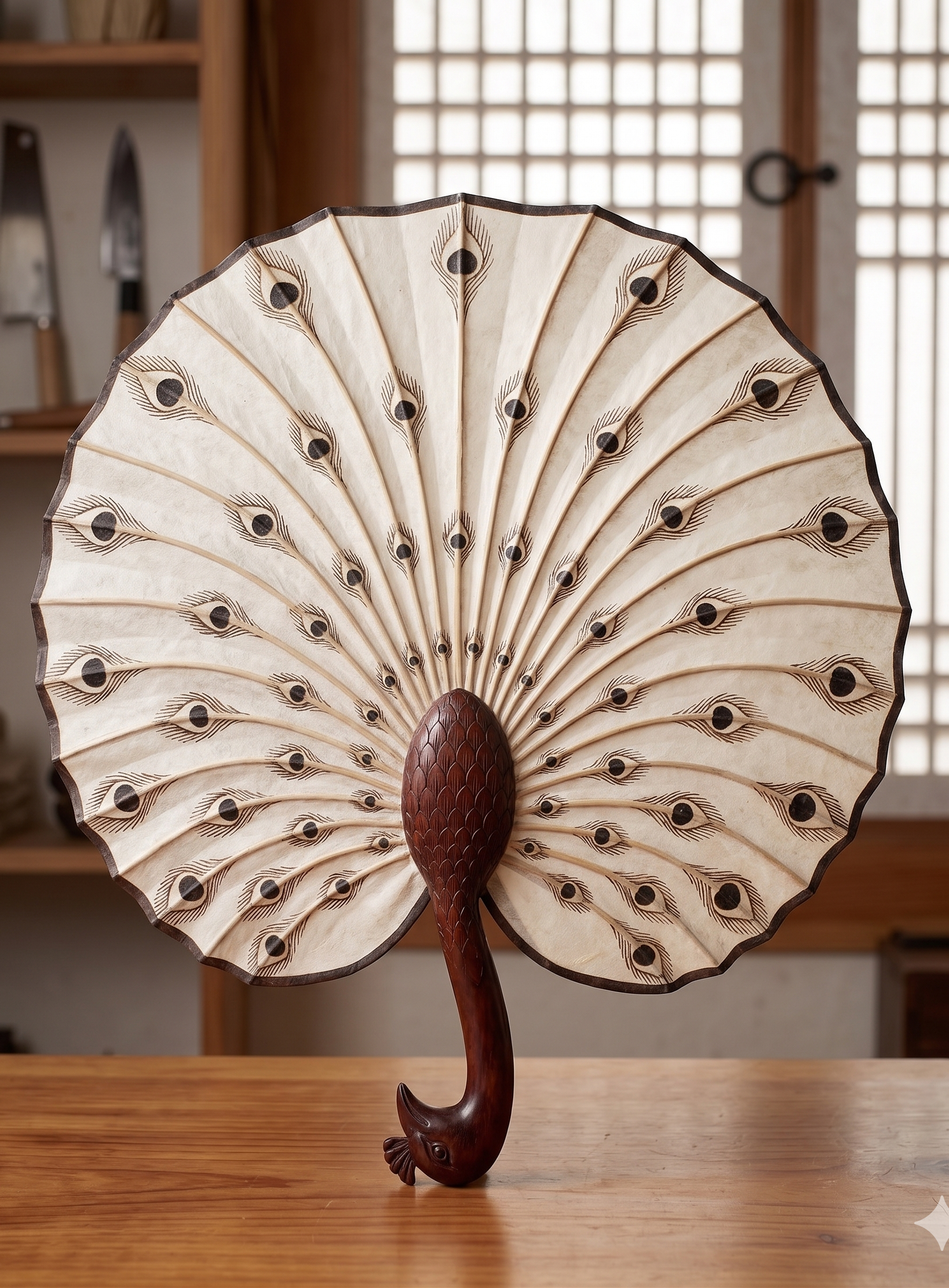
Under the eaves of a workshop in Seocheon, South Korea, an elderly craftsman chips away at a dense block of wood. At eighty years old, Master Lee Kwang-gu (이광구) is the designated artisan for Seocheon Fan Making (Seocheon Buchae-jan) — and the nation’s last remaining master keeping the rare tradition of the gongjak-seon (공작선) — the majestic peacock fan — alive.
Recognized as an Intangible Cultural Heritage holder, Lee has dedicated over six decades to preserving these hand-carved Korean peacock fans, staying true to a slow-craft lineage that has served as his family’s lifeline for four generations.
The Lee’s Legacy
To look at a gongjak-seon in Master Lee’s workshop today is to confront a century of domestic stubbornness. While the grandiose display of the peacock fan appears purely artistic, its survival into the modern era required a gritty, desperate persistence from the working-class margins of South Korea.
Master Lee Kwang-gu, the eldest of four siblings, left school early to commit his hands to the family trade. For over 60 years, he labored under the craft passed down from his “father’s father’s father,” inheriting the formal title of Seocheon Buchae-jang in 2008 from his late father, Lee Han-kyu. But long before the practice was protected by the state as an Intangible Cultural Property, it was simply an unyielding family obsession.
During the leanest decades of the twentieth century, gongjak-seon making survived underground. Lee’s grandfather, Lee Eul-yong, worked the brutal shifts of local coal mines, retreating to his wife’s family home to sculpt fans in his few off-hours. It was during this era of hardship that an obsessed Japanese collector tracked down the family, begging to buy an heirloom piece crafted by his father, the first-generation patriarch, Lee Gun-jung.
Lee Gun-jung originally exclaimed, “This is a sacred family relic, don’t you dare sell it.” Yet, when confronted with the literal survival of his children, the second-generation craftsman bartered exactly half of that legacy, trading one of their two remaining heirloom fans for five mal — forty kilograms— of rice. In that transaction, the fan quite literally sustained the family bloodline.
Decades later, third-generation Lee Han-kyu, who balanced carpentry with fan-making, sold the remaining twin relic to an antique collector at a premium to fuel the family’s survival. He continued crafting the fans, eventually enlisting and teaching his four children to help. At one point, he even raised live peacocks to study the precise geometry and splay of their tail feathers.
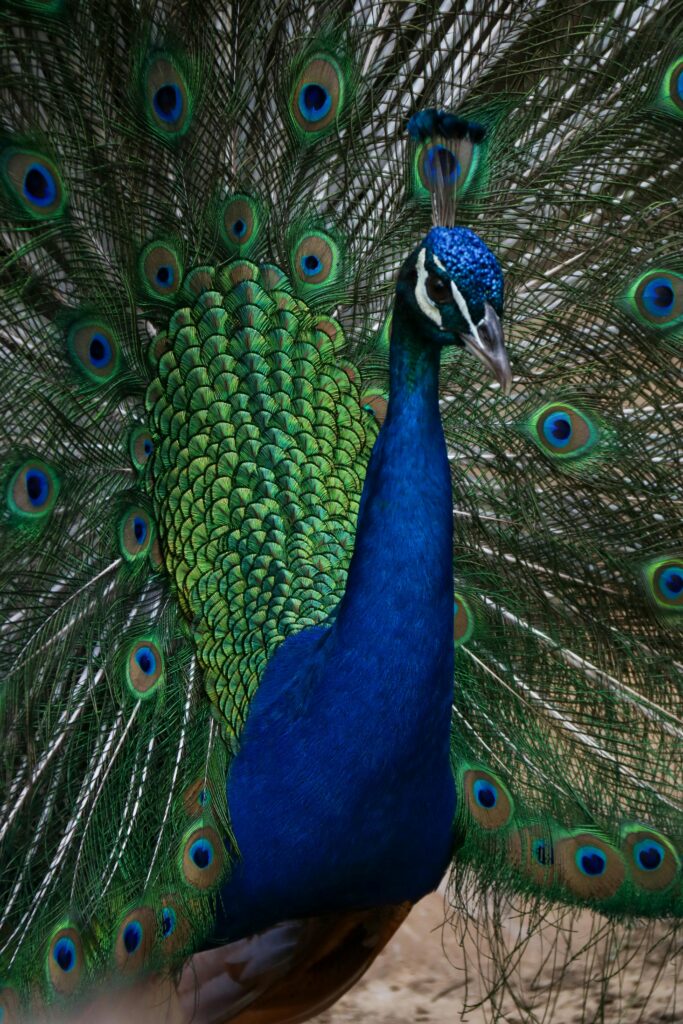
At one point, Lee Kwang-gu’s father, Lee Han-kyu, raised peacocks to study their feathers’ geometry and inform the design of their gongjak-seon (peacock fan).
Though modern economic pressures forced fourth-generation Master Lee Kwang-gu to occasionally take on outside labor to provide an education for his own children, the workshop floor was never abandoned. Today, he stands as the sole remaining link to the gongjak-seon tradition in South Korea, though the craft’s future is already taking root in the next generation.
His youngest son, Lee Hyung-bok, alongside his third son-in-law, Yoo Bang-seok, have stepping in, training to carry the mantle, though they are seeking to welcome more. Together, their hand-made fans continue to express the fierce elegance of the craft — a testament to a lineage that chose preservation over convenience for an art form that once belonged entirely to kings.
Gongjak-seon’s Royal History
While the Lee family has guarded the craft for four generations, the peacock fan traces its lineage back over a millennium to the dawn of the Goryeo Dynasty. Codified in the Samguk Sagi (History of the Three Kingdoms) — Korea’s oldest surviving historical record — a prominent official recounts the moment the ornate gongjak-seon (孔雀扇) came into power.
Upon his ascension to the throne in 918, Goryeo’s founding monarch, King Taejo Wang Geon, was presented with a coronation gift from his regional rival, King Gyeon Hwon of the Later Baekje kingdom. The gift was a majestic fan crafted from the iridescent, plucked feathers of a male peacock. Spanning wide to mirror the bird’s tail, the gongjak-seon was instantly canonized as a symbol of power and beauty. Within the court, these fans were wielded by attendant servants behind the throne, fanning and providing shade for the king.

King Taejo Wang Geon, founding monarch of the Goryeo Dynasty, sitting on his throne with a gongjak-seon (peacock fan) in hand. (Source: Ebadollah, CC BY-SA 4.0, via Wikimedia Commons)
Over the centuries, this palace art form trickled down to extended nobility before undergoing a material evolution during the Joseon Dynasty. As access to exotic plumage shifted, master craftsmen swapped fragile feathers for more durable native hanji (mulberry paper). By dyeing and layering this resilient paper, artisans democratized the elusive royal luxury into a masterpiece of local, organic materials, all while preserving its unmistakable, regal silhouette. Hanji fans have persisted ever since, passing directly into the hands of Master Lee.
The Crafting Process
Currently, Mr. Lee Gwang-gu, along with his wife, fellow artisan Ms. Yoo Jin-soon, has moved into a craft workshop near the Hansan Ramie Museum in Seocheon. Together, aside from running fan-making experience programs, they continue to carry out orders for their custom fans, which take about 2-3 months to make. The craft requires mastery of both wood carving and painting.
Carving the Handle
Master Lee’s fans are anchored by his signature, intricately hand-carved chamjuk (Chinese toon) wood handles. This specific timber is selected not only because it traditionally represents longevity, but for its remarkable material properties. Its dense, hard nature makes it highly resistant to damage, it takes a natural polish exceptionally well without artificial varnishes, and its natural reddish-brown grain deepens into a rich amber hue with age.
Cross-legged on the workshop floor, Lee picks up a metal mallet to hammer away at a carefully selected block, chipping through the stubborn hardwood to coax out the nascent curve of a peacock’s profile. For the gongjak-seon specifically, the handle must be sculpted into a continuous, fluid form representing the bird’s head, neck, and belly. Achieving this anatomy requires immense physical expertise. The handle must be perfectly balanced to ensure the radiating bamboo skeleton will not sit crooked and warp the final piece.
Lee executes this demanding architectural symmetry completely by eye and muscle memory, refusing templates or measuring equipment. Using a knife to hand-carve fine details before smoothing down with sandpaper, he finishes a handle that curves elegantly up to the bird’s belly seam, where the fan ultimately unfurls.
Preparing Bamboo Spokes
Equipped with a saw, Master Lee walks his bicycle to a nearby bamboo forest to select a suitable stalk for the fan’s framework. He specifically seeks three-to-four-year-old bamboo, prized for its natural elasticity. Using a knife or ax, he splits an internode into narrow strips, refining each individual spoke by hand. A small sanding machine — the only automated tool in his entire workshop — is used to smooth out the pieces before he lays out the intricate skeleton of the gongjak-seon.
Fan maker Lee Kwang-gu uses 3-4-year-old bamboo to create the spokes for his gongjak-seons (peacock fans).
Locking the Curve
With the handle sculpted and the bamboo spokes mapped out, Master Lee establishes the skeleton of the gongjak-seon. He pins the split strips onto a plywood-backed metal sheet, hammering nails into a constellation of existing puncture holes that dictate the fan’s elegant curvature. His wife, Yoo Jin-soon, often keeps him company, handing him nails one by one as he reinforces the frame.
Once the bamboo is pinned flat against the template, Lee passes a gas blowtorch over the arrangement for ten minutes, altering the physical properties of the wood to lock it into position. This intense flash-heating forces trapped moisture and natural oils to the surface, relaxing the internal cellulose fibers so they yield entirely to the template’s curve. As the frame cools, these fibers harden back into a rigid, permanent state, stripped of their natural impulse to spring back straight. Beneath the flames, the underlying metal sheet acts as a vital heat sink, absorbing excess thermal energy to ensure the bamboo shapes evenly without burning through.
Paper Application
Lee’s wife, Yoo Jin-soon, then takes the frame to execute baram baejop — a precise layering process using hand-mixed paste to adhere hansan-mosi (fine ramie fabric) and hanji (mulberry paper) to the bamboo.
To finish the paper, the couple performs dochim, a traditional pounding technique that compresses the fibers into a smooth, leathery texture. But instead of swinging a heavy wooden mallet, Master Lee sandwiches the fan between two foam sheets and proceeds to step on it, using his own body weight to ensure proper adhesion. Once complete, the excess bamboo ribs and fabric are trimmed, and the fan is laid out to sun-dry for at least half a day.
Painting and Finishing
After drying, the gongjak-seon is hand-painted with peacock eyelets and fine feather details. To protect the design, Yoo Jin-soon applies raw perilla oil stored in a classic green soju bottle to strengthen and preserve the piece while enhancing its visual vibrancy. The oil permeates the paper, curing it into a water-resistant finish. Once dry, the fan transforms from a collection of raw materials into a finished object of sculptural authority — a silhouette saved from history, resting on a workshop bench.
See kachi.service for more information on how to support Master Lee Kwang-gu’s work or visit his workshop.